8.32 Adrenocortical Tumours
Typical Patient
- Often discovered incidentally – adrenal incidentaloma incidence increases with age (7% above age 70)
- Can seen in patients with rare genetic syndromes (e.g. LiFraumeni, Von Hippel-Lindau, MEN1/MEN2, Beckwith-Wiedemann syndrome)
Cause
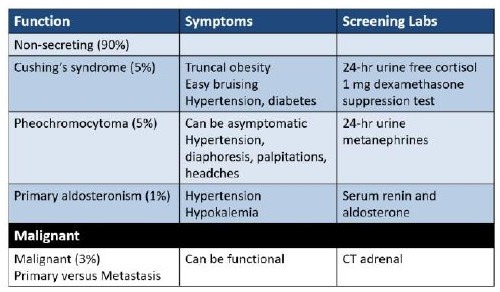
- Functional – Cushing’s syndrome, Conn’s syndrome, hyperandrogenism syndromes
- Non-functional – many are discovered incidentally
- 90% of adrenal incidentalomas are benign and non-functional
Symptoms/Clinical Presentation
- Often asymptomatic
- Abdominal pain and mass
- Weight loss, weakness, fever
- Anorexia, nausea, vomiting
- Lymphadenopathy, hepatomegaly
- Hypertension
- Endocrine manifestations
Physical Exam
- Measure vitals for hypertension and fever
- GI exam for abdominal mass/pain
- Lymph node exam
- Strength test to detect muscle weakness
Investigations
- Dexamethasone suppression test
- 24-hour urine metanephrines
- Serum electrolytes, renin, aldosterone if hypertensive
- CT adrenals
Management/Treatment
- Surgery
- Radiation
- Chemotherapy
32 “Adrenal Disorders”, Erin Keely, November 1 2016, uOttawa Faculty of Medicine 33 Fassnacht M, Arlt W, Bancos I, Dralle H, Newell-Price J, Sahdev A, Tabarin A, Terzolo M, Tsagarakis S, Dekkers OM. Management of adrenal incidentalomas: European Society of Endocrinology Clinical Practice Guideline in collaboration with the European Network for the Study of Adrenal Tumors. Eur J Endocrinol. 2016 Aug;175(2):G1-G34. doi: 10.1530/EJE-16-0467